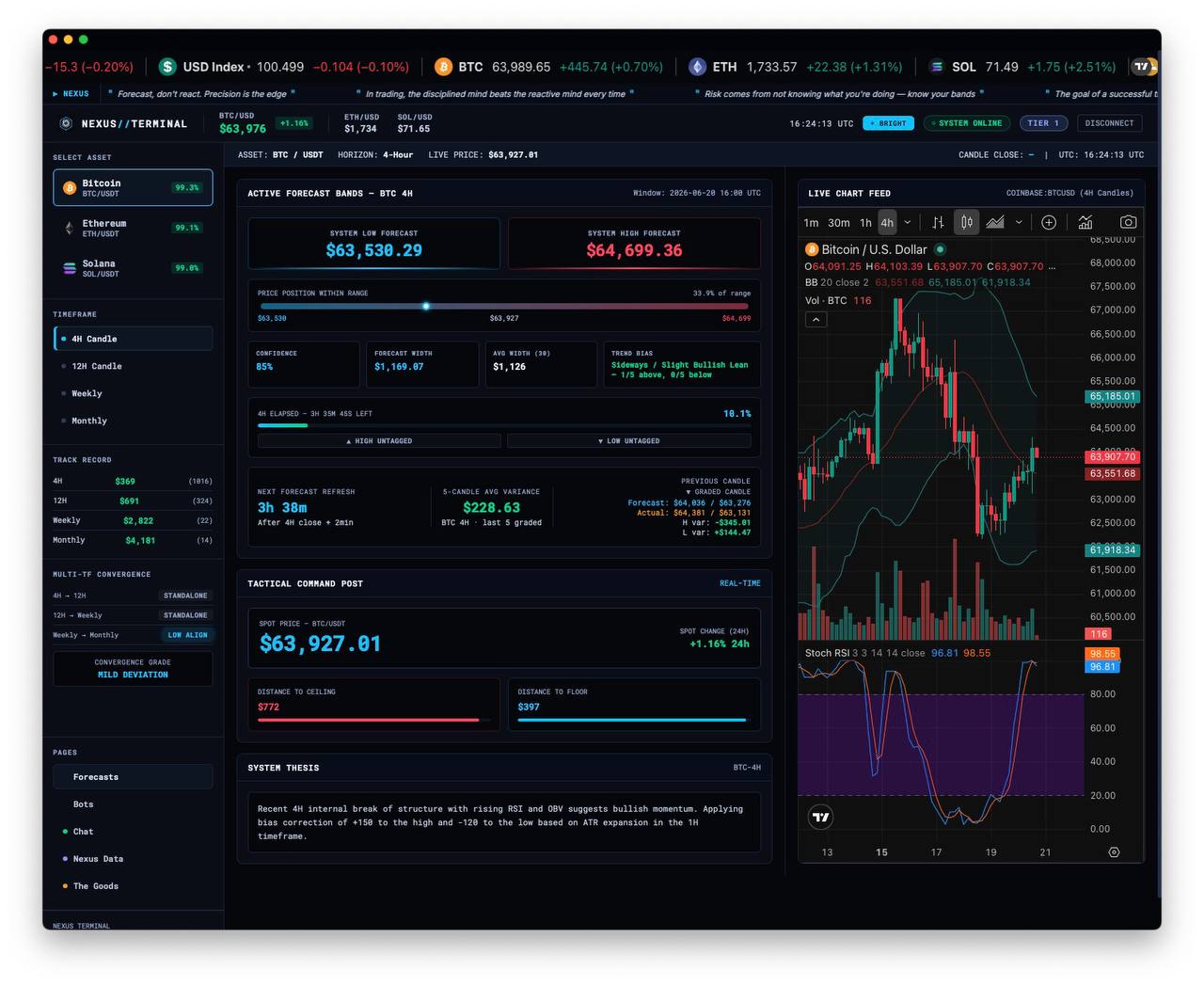
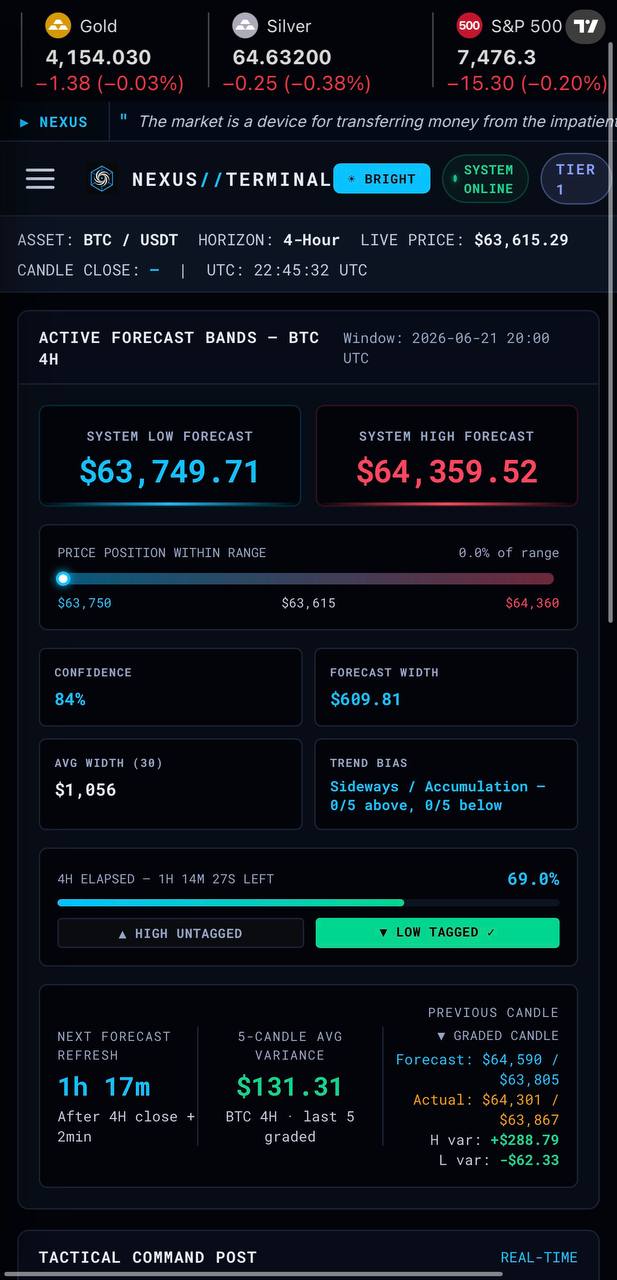
Every forecast is delivered to your Nexus Terminal web interface and available via REST API. Here's a real BTC 4H output, walked through piece by piece so you know exactly what to expect before you subscribe.
Every Nexus market — crypto, indices, equities, and metals — gets this same structured output across 4H, 12H, Weekly, and Monthly timeframes.
These are real screenshots from the Nexus experience. The desktop app is the main view. The phone view keeps the same signal in a compact layout for mobile.
The desktop app is the premium view. Mobile stays clean and scrollable. Forecasts are also available through the API, and the asset list is expanding as the launch finishes up.
BTC · ETH · SOL · Gold · QQQ · S&PThe screenshots above are the main product preview. This section just explains the core pieces so you know what you’re looking at when a forecast lands.
Shows which asset and timeframe this forecast targets, plus the exact candle it was built for.
The key detail is the Window line — it proves the forecast was created before that candle opened.
Trend Bias is the structural read — sideways, bullish, bearish, accumulation, distribution, and so on.
Confidence tells you how strongly the structure lines up across the indicators and recent performance.
The System High and System Low forecasts define the expected candle range.
Forecast Width is the width of the band. Wider means more volatility. Tighter means compression.
This is the plain-English read of why the band looks the way it does — trend, momentum, and key levels.
The prior candle’s forecast is graded against the actual candle that closed.
That way every new forecast lands with context, not just numbers.
Every forecast is delivered two ways. Pick the one that fits your workflow — or use both.
Interactive desktop web app. Multi-asset dashboard, live charts, candle progress tracking, forecast history, system thesis, and graded track record. All in one place.
Preview the Terminal →Real-time JSON over REST. Authenticate with your API key, request forecasts for any asset and timeframe. Build your own trading bots, dashboards, or analysis tools.
/api/signal?asset=BTC&tf=4H
You've seen the output. Here's how to calibrate against recent precision, handle weekends, and fit Nexus into a real trading process.
System High Forecast / System Low Forecast — The projected range for the candle. These are the levels to watch: does price stay inside the band, break above, or break below?
Forecast Width: $317.94 — The band size. Tells you how much volatility the system expects for this candle.
Avg Width (30): $587.15 — The average band width over the last 30 candles. If the current forecast width is well below the average, the system expects compression; well above it, expansion.
Compare Forecast Width against Avg Width (30). A much wider band than usual means the system sees something — higher conviction levels, sharper moves expected. A tight projection in a normally volatile window is a flag to watch closer.
A moving snapshot of recent precision:
$137.80 — the average miss (Mean Absolute Error) across the last 5 graded candles, combining both sides of the band. The Terminal also tracks a 30-candle Rolling MAE per timeframe so you always know the current precision regime.
Rolling MAE is your calibration tool. If the 4H Rolling MAE is $137 and the band is $300 wide, the system has been landing tight. If MAE has been swelling, give the edges more respect. Judge every new forecast in the context of the current precision regime — the numbers to do it are always on screen.
Weekend candles behave differently. Lower volume, wider spreads, less noise but also less conviction. This is one of the most common sources of surprise for new subscribers.
What you'll notice: Weekend forecasts often show tighter projected widths and more neutral bias. The system isn't guessing less — the underlying structure is genuinely flatter.
A weekend range that looks "safe" can get violated immediately when Monday volume returns. Sunday night into Monday morning is the most common transition period for a forecast to get caught offsides.
How to adjust:
Nexus is a range forecaster, not a buy/sell signal. Here's how it fits into real trading:
You know the projected high and low before price moves. You can plan entries, exits, and invalidation levels in advance instead of reacting.
The high and low targets are the levels that matter. If price approaches the high target and the bias is bullish, you have context for a potential breakout. If it approaches with bearish bias, the top of the range becomes resistance. Same logic for the low target with inverted bias.
Rolling MAE is your calibration tool. It tells you exactly how far the bands have been missing lately, in dollars. Know the recent precision before acting on any single forecast — the Terminal shows it per asset and per timeframe, updated with every graded candle.
The thesis gives you the structural story. If it aligns with your own read, that's confirmation. If it contradicts, that's a flag to look closer. You don't have to agree with it — but you should know what it's seeing.
The best users of Nexus are selective. High-confidence forecasts where the thesis matches their own read are the ones to plan around. Low-confidence or uncertain-bias forecasts are a signal to sit out. The system tells you when it's less sure — listen to that.
Every forecast is graded the same way:
Each closed candle produces a graded receipt: PERFECT HIT (both sides landed well inside tolerance), IN MAE RANGE (misses within the published threshold), ONE-SIDE BREACH (one side exceeded it), or MISS.
Alongside the grade, every miss is measured in dollars — High Error, Low Error, and candle MAE — and rolled into the 30-candle Rolling MAE you see in the Terminal and on the public track record.
This is a deliberately transparent standard. Most "forecast" products hide their misses. Nexus publishes every error in dollars, live, for every market — the receipts are the product.
The track record on the site updates automatically: all-time, 90-day rolling, and 30-day rolling. Every forecast gets graded. No snapshots, no cherry-picked periods.
Forecasts will miss. No system is perfect. The question is whether the misses are informative — whether you can see why a forecast missed and adjust accordingly. The Rolling MAE is designed exactly for this: it gives you the context to evaluate the next forecast in light of recent patterns.
Yes — that's the intended use. Nexus gives you a structured, accountable range forecast. Your job is to use it alongside your risk management, entry rules, and market judgment. The thesis tells you the system's reasoning. The Rolling MAE tells you its recent precision. You bring the strategy.
Every candle close for your subscribed timeframes. 4H = every 4 hours. 12H = twice daily. Weekly = once per week. Monthly = once per month. Each arrives in your Nexus Terminal automatically, with optional push alerts on desktop and mobile.
If you want entry signals, take-profit targets, or someone to tell you when to buy and sell, Nexus is not that product. It's a range forecaster. It tells you where price is likely to trade, not what to do about it. That's intentional — your strategy is yours.
The system delivers structured, accountable forecasts before every candle. You bring your strategy, your risk management, and your judgment. Nexus brings a clear, consistent read of what's coming next.
Crypto, indices, equities, and metals — same structured output across 4H, 12H, weekly, and monthly. Auto-delivered after every candle close. Viewable in your Nexus Terminal or pulled via API.
Subscribe Now — $100/moNexus Terminal credentials delivered immediately. Tier 2 adds API credentials and the Bot Guide PDF; Tier 3 adds Paper Lab, BYO AI, and the control-system download.